S3 Table Buckets
A table bucket is an ordinary S3 bucket that also behaves as a table catalog. You create one, point a query engine at its catalog endpoint, and read and write tables — with no external metastore to deploy: no Hive Metastore, no Nessie, no AWS Glue. The tables’ data and metadata are plain objects in the bucket, so they inherit everything SeaweedFS does for the rest of your storage — replication, erasure coding, and cloud tiering. It’s all part of open-source SeaweedFS.
Two formats, two catalogs
A table bucket holds exactly one table format, and its format decides which built-in catalog serves it:
- Iceberg — Apache Iceberg tables through a built-in Iceberg REST catalog (default port
8181). Any Iceberg engine — Spark, Trino, ClickHouse, Dremio, DuckDB, PyIceberg — connects with the standard REST catalog protocol. - Lance — Lance datasets, the columnar/vector format behind LanceDB, through a built-in Lance Namespace (default port
9101). LanceDB connects withconnect_namespace("rest", ...).
Both catalogs authenticate with your S3 credentials, and both run side by side — one cluster can serve Iceberg and Lance buckets at once.
Create one
weed mini (and full deployments) pre-create buckets with -tableBucket, where each name takes an optional :FORMAT suffix (default ICEBERG):
# an Iceberg warehouse and a Lance vector bucket, side by side
weed mini -dir=./data -s3.config=s3config.json -tableBucket=warehouse,vectors:LANCE
On an already-running cluster, create one from weed shell:
s3tables.bucket -create -name vectors -format LANCE -account 000000000000
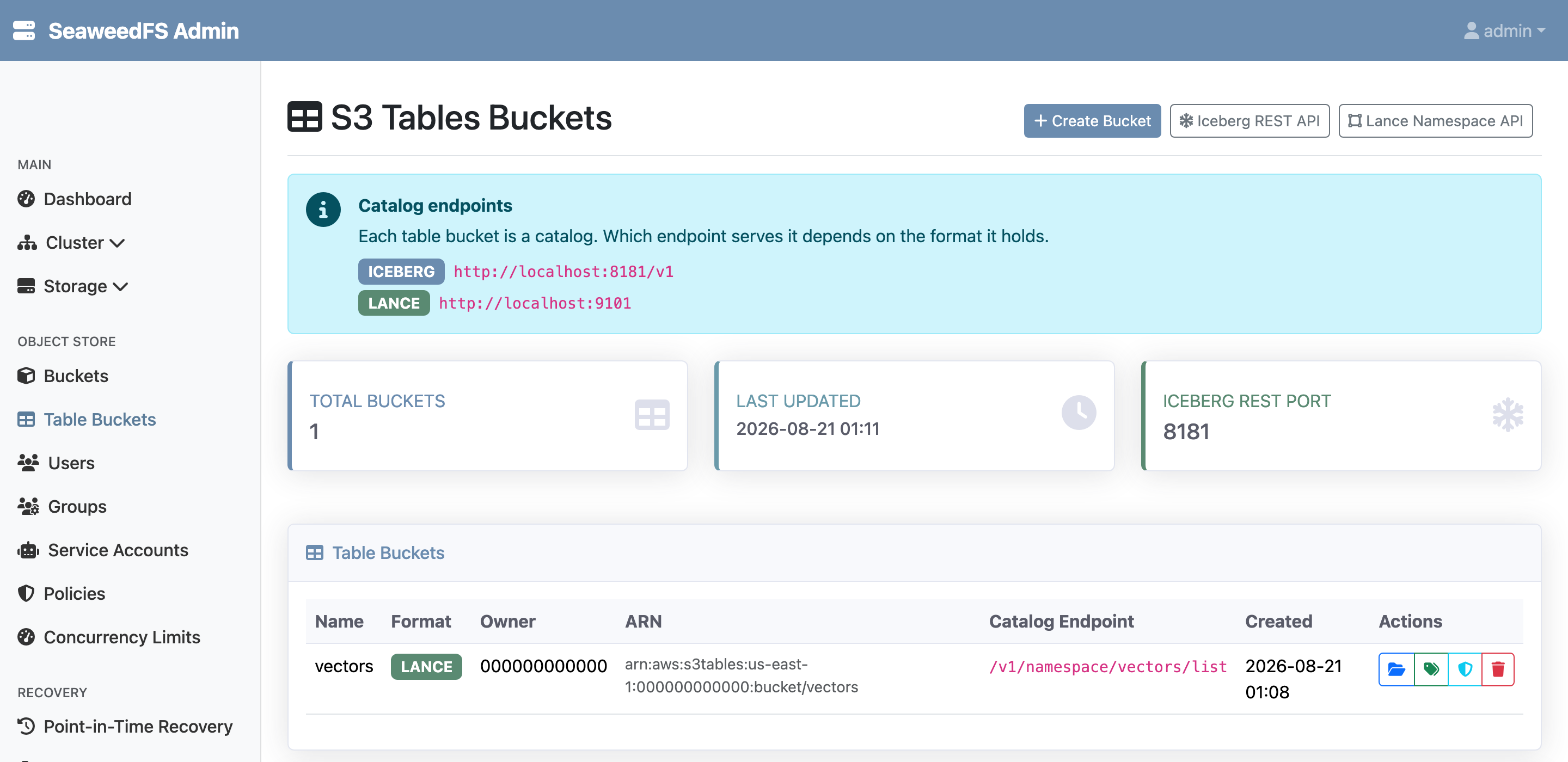
The Admin UI’s Table Buckets page lists every bucket, the format it holds, and the catalog endpoint that serves it:
Query it with
Step-by-step walkthroughs, each run end to end with real commands and output:
- Querying with DuckDB — attach an Iceberg table bucket from DuckDB and run SQL.
- Running ClickHouse — ClickHouse’s
DataLakeCatalogengine reads and writes Iceberg tables through the catalog. - Vector search with LanceDB — declare a Lance table, build an IVF_PQ index, and run nearest-neighbor search.
Or use both formats together:
- Analyze with Iceberg, serve with Lance — a two-format lakehouse on one SeaweedFS: analytics in Iceberg, fast lookups and vector search from Lance, joined in DuckDB.
Keeping tables fast
Streaming or frequent small writes leave tables with many tiny data files and stale snapshots that slow every scan. SeaweedFS compacts and cleans them automatically, on dedicated workers, with no separate compaction service to run — see Iceberg Table Maintenance. Any engine that reads through the catalog picks up the compacted tables with no changes on its side.